|

HAPPY THANKSGIVING!
It’s no secret that this past year has been a crazy one. The historic economic downturn affected countless businesses and millions of people in ways that are perhaps best left to distant memory. We survived, and even managed to thrive, during this difficult time thanks to a loyal network of past customers and hard working real estate agents who continued to refer business our way. We are grateful. Thank you!!!
|
|
ANNOUNCEMENTS
|
FIRST NEWSLETTER
It's finally here! Over the course of performing thousands of home inspections, we have often thought "Hey, this would be helpful for people to know." What better way to convey these miscellaneous tips and observations than to put it into a newsletter. We hope you find the information handy. And, feel free to forward it to others who might be interested. We will try to keep the topics relevant and useful. But, if you have a burning question, email us. We will try to answer the question in one of our future issues. And, don't forget to check out the monthly CONTEST below.
INSPECTOR LICENSING LAW
The new Washington home inspector licensing law went into effect September 1, 2009. Short answer: Yes, we're licensed. Long answer: To read more than you want to know about licensing and certification in the home inspection industry, read our page on Licensing and Certifications.
NOW ACCEPTING VISA/MC
Why is it that every product or service under the sun can be purchased with a credit card—but not a home inspection? That’s precisely the question we asked ourselves one day. The answer? Now you can. To answer your next question, no, there are no additional fees for this convenience.

|
|
TECHNICAL CORNER
|
|
DIVERTER FLASHING (aka KICK-OUT FLASHING)
Where: Found where a roof meets a vertical wall--installed at the edge of the roof line, at the end of step flashing.
Purpose: To divert or channel water flowing down the roof into the gutter rather than onto the wall beneath. (The white object in the photo below is the diverter flashing. The copper colored flashing along the wall is step flashing.)
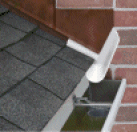
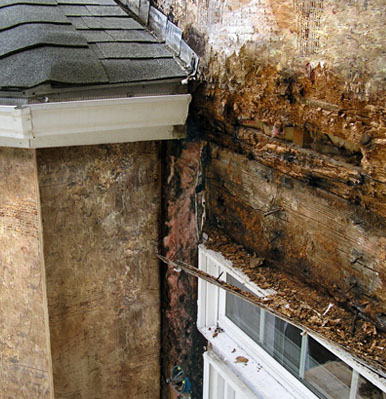
When things go badly: When there is no diverter flashing to channel water into the gutter, water flowing along the joint between the roof and the vertical wall will flow onto the wall beneath. Over time, water seeps into cracks and unsealed seams and can cause decay and structural damage to the house.
Who can install: Skilled homeowner or roofing contractor.
|
|
CONTEST: WHAT IS IT?
|
|
WATER HAMMER
Be the first to send in a great description of our featured word in 50 words or less and win a $25 Starbucks gift card! The winner's description will be posted in a subsequent newsletter.
Write and send
|

|
MANAGING WATER AROUND YOUR HOME
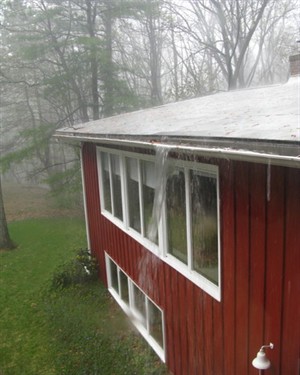
Admit it. You chuckled a little looking at this photo of mini-Snoqualmie Falls pouring off some poor guy’s rain gutter. It reminded you of your own neglected gutters and made you wonder how many years it has been since you even thought about cleaning it. (For those of you who are surprised to hear that gutters need to be cleaned—brace yourself for more bad news). The two thousand pounds of yard waste the maples just shed probably didn’t help the situation. And, considering November is the official kick-off to an eternity of wet and gray in the Pacific Northwest, the problem won’t be going away any time soon.
Unfortunately, finding alternate paths to avoid getting soaked by these unintended cascades isn’t enough. While our bodies need this clean and pure substance in abundance, water is kryptonite to houses and is responsible for more damage and destruction than even natural disasters. So, unless you have a large grant to study the decaying properties of mold or are attempting to host the world’s largest colony of carpenter ants in your home, remember that nothing good can come of wood and moisture.
Do your house a favor. On one of the many rainy weekends we have in the Seattle area, go outside and make a list of all the potential water issues you see. Some things to check are:
- Are downspouts positioned to discharge water away from the house? (Preferably extended to discharge at least 4 feet away from the structure)
- Are there splash blocks beneath the downspouts to prevent water from eroding the soil and getting to the foundation?
- Are the gutters or downspouts sagging, leaking, disconnected or clogged?
- Are diverter flashings in place and working? (See Technical Corner in this issue for more details)
- Are the roof valleys free of leaves or debris? (Do not go on the roof on a rainy day—especially if you have a metal or cedar shake roof, which can get very slick.)
- Is there water ponding around the house?
- Is there any water draining toward the house—even the smallest rivulet?
- Is the site graded so that it slopes away from the house? (There should be at least a 6 inch drop for every 10 feet)
- Are there at least 6 inches of clearance between the siding and the soil below, which will help prevent water from contacting the siding and to keep wood-destroying pests at bay?
- Vegetation should be kept trimmed to at least 12 inches from the house, which helps prevent pests from making contact with the house and allows sun and air circulation to dry building materials.
- Are there any signs of water, including excessive dampness in the basement or crawlspace?
- Is there a vapor barrier covering all exposed dirt in the crawlspace? (Black plastic preferred)
- Are there any signs of an active water leak in the attic?
- Did you notice any ice damming last winter—and did you get it fixed?
- Are there signs that indicate water damage may have already begun--such as siding that is buckling or swollen?
- You can probably switch off the automatic sprinkler system at this time. But, if you are a green lawn zealot, at least remember to position sprinkler heads so that they don’t spray onto the house. Better yet, replace the ones along the perimeter of the house with drip irrigation types.
- Go around and look at the house one more time for any other issues that might cause water to have prolonged contact with building materials. Even in areas where water contact is to be expected, such as the roofing or siding, you want to minimize contact time by making sure water can drain off quickly and effectively and have an opportunity to dry. Even building materials that were specifically designed to be a barrier against water intrusion, such as synthetic stucco (or EIFS), has had problems with water seeping in and causing damage to the structural materials beneath it.
Now that you’ve assessed the situation and made a list (hopefully), schedule a dry weekend to tackle the maintenance and repairs. This may be a good time to invest in a good DIY home maintenance book.
Too busy testing turkey recipes to deal with home maintenance?
If you lost interest about 3 bullets down, you might want to consider scheduling a home maintenance inspection with a reputable inspection company. (One comes to mind.) Why get soaked staring blankly at something that you have a gut feeling is bad but don’t know enough about construction, or care to know, to identify the problem. And, a professional home maintenance inspection covers a whole lot more than droopy gutters. Consider it a holiday gift to yourself—the gift of time and convenience.
CALL US: 425-220-7183
If you are a handy sort and decide to brave the inspection yourself, know that we’re here answer your questions if you run into a tricky spot. Whichever way you decide to go about it, just make sure you don't let another season go by without addressing water issues around the home.
STAY TUNED: One of our future issues will highlight tips for controlling moisture inside the home.
------------------------------------------------------------
STORING FIREWOOD
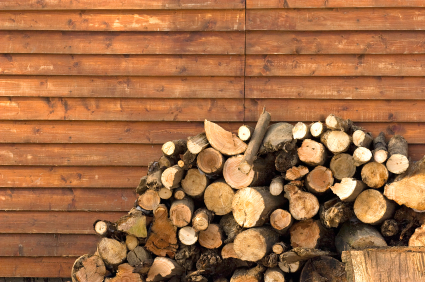 There is nothing cozier on a cold winters night than a great big pile of logs burning in the fireplace. And, with energy prices rising, you may even be tempted to burn logs and switch off the natural gas. Whether you plan to burn for ambiance or for household heat, you should keep a few things in mind when storing or seasoning firewood. While it is admittedly convenient to have your cache close by, stacking firewood against an exterior wall of the house is a bad idea. Not only can infestations of termites and other wood destroying pests start under a pile of firewood and quickly spread to the house, large stacks can prevent siding and other building materials from drying. A good alternative is to stack your firewood on a sturdy metal grate, which will keep logs off the ground and supported without the aid of a wall. There is nothing cozier on a cold winters night than a great big pile of logs burning in the fireplace. And, with energy prices rising, you may even be tempted to burn logs and switch off the natural gas. Whether you plan to burn for ambiance or for household heat, you should keep a few things in mind when storing or seasoning firewood. While it is admittedly convenient to have your cache close by, stacking firewood against an exterior wall of the house is a bad idea. Not only can infestations of termites and other wood destroying pests start under a pile of firewood and quickly spread to the house, large stacks can prevent siding and other building materials from drying. A good alternative is to stack your firewood on a sturdy metal grate, which will keep logs off the ground and supported without the aid of a wall.
|

